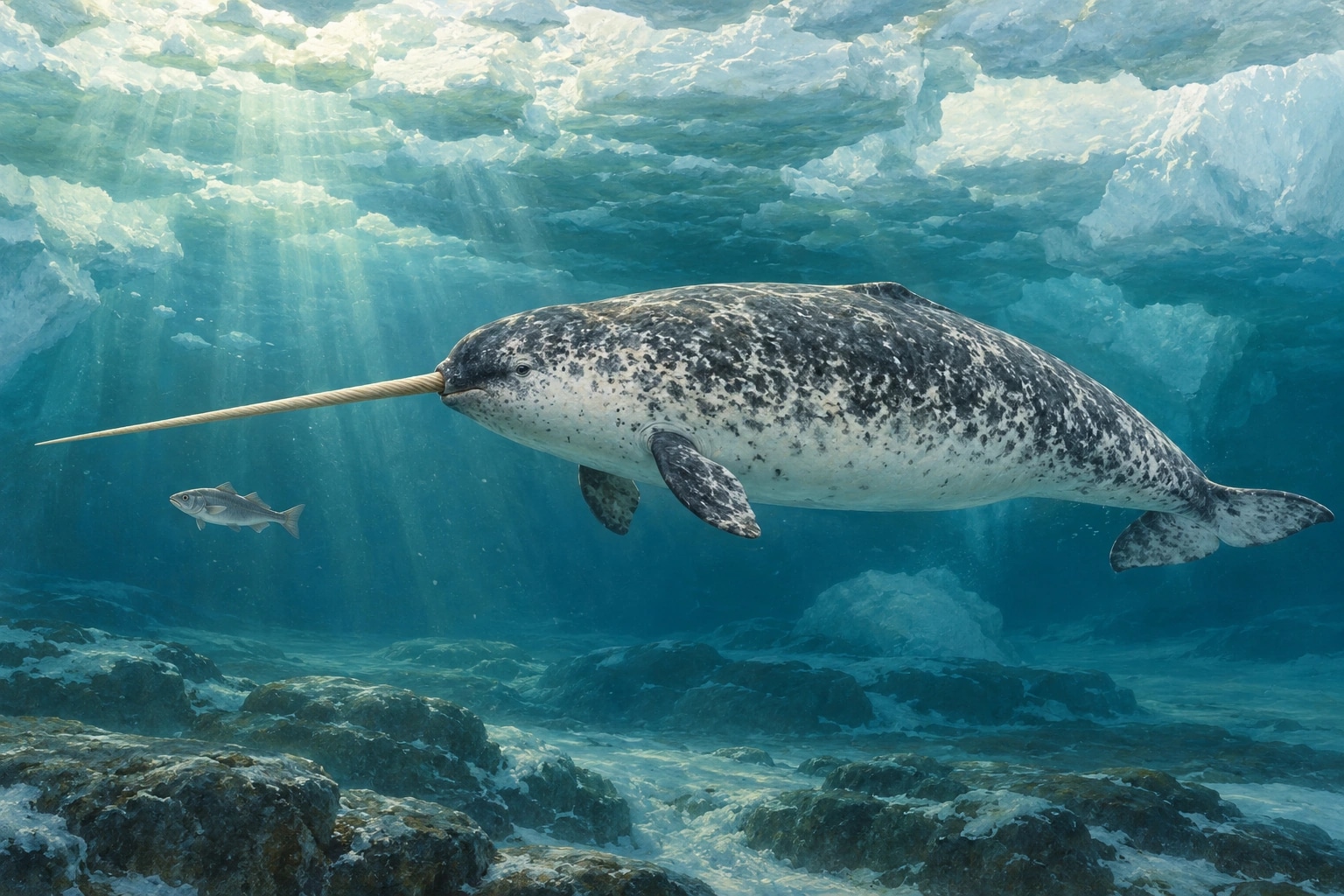
A tooth, growing from the jaw
The narwhal, Monodon monoceros, is an Arctic whale. Its celebrated tusk is an elongated tooth, usually the left one of the upper jaw, not a horn growing from the forehead. It is predominantly a male feature, but NOAA records exceptions: females with a tusk, males without one and individuals with two. The familiar silhouette is therefore a useful introduction, not a description of every narwhal.
More than a single-purpose tool
NOAA describes the tusk as a male secondary sexual characteristic, associated with social assessment and possibly mate choice. A potential sensory role is also discussed in the scientific literature. These explanations need not exclude one another. A structure can matter in social encounters and also interact with the surrounding environment. Calling it simply a weapon, a thermometer or a fishing spear gives more certainty than the evidence supports.
What drones actually recorded
A study published in Frontiers in Marine Science in February 2025 analysed encounters in Canada’s High Arctic. Researchers filmed narwhals pursuing fish and using their tusks to strike, manipulate and influence them. Some actions were associated with feeding; others were interpreted as exploration and likely play. That last word matters: the team described a behavioural interpretation, not direct access to what the whale was thinking. These observations do not show that all narwhals always hunt this way.
Look beyond the tusk
The animal has a rounded head, a mottled body and no dorsal fin. NOAA also describes suction feeding, which helps explain why the tusk should not be imagined as a permanent skewer for every meal. Next time you see a narwhal image, look at where the tooth emerges and how the body is shaped. The striking detail is real; the animal behind it is more varied, and its behaviour less completely understood, than a neat nickname suggests.