Start with the right animal
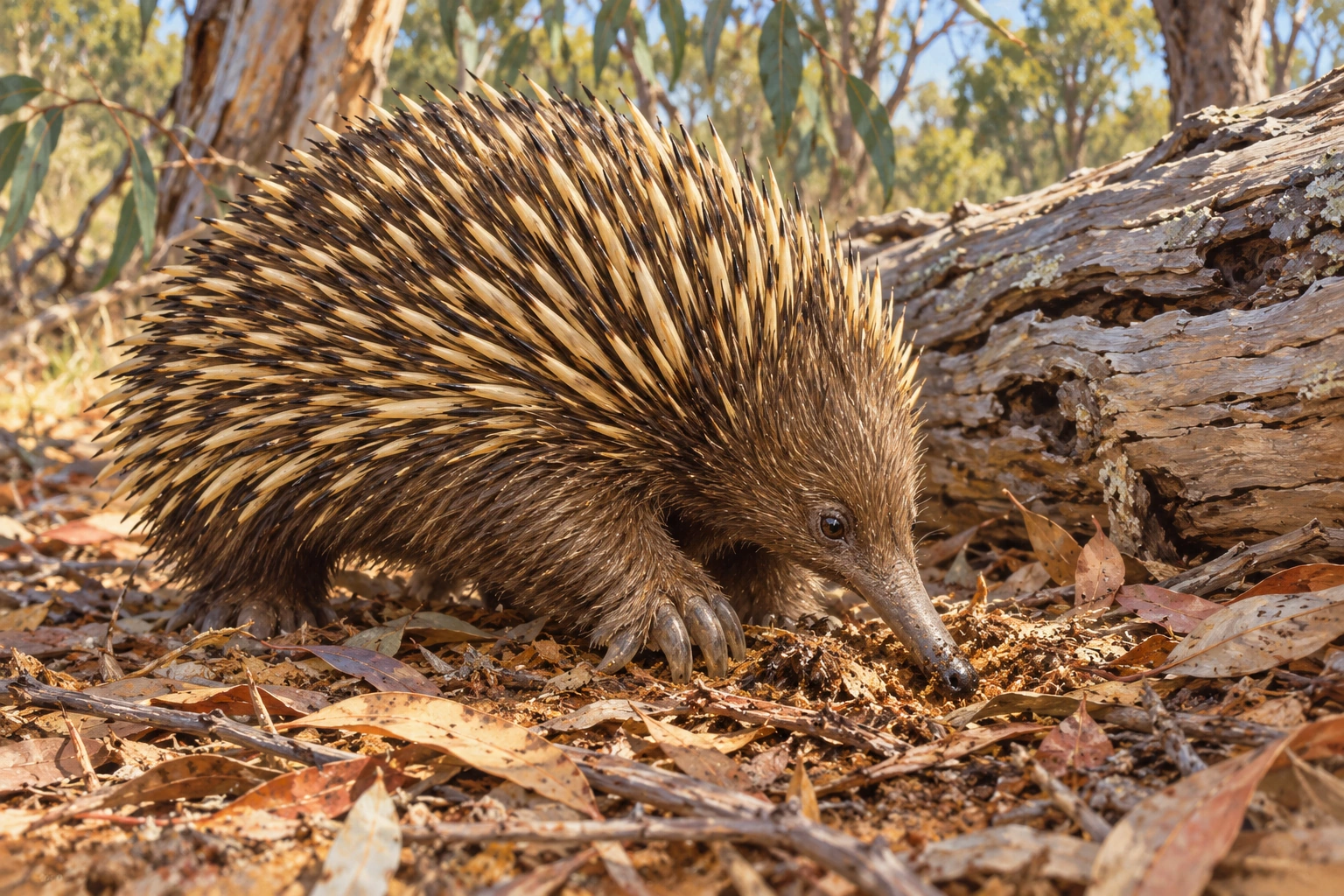
The short-beaked echidna, Tachyglossus aculeatus, is a mammal whose spiny outline is only the beginning of the story. The Australian Museum describes short legs, sharp spines and a long snout. Look closer at that snout and the strong digging feet: this is a particular animal with a particular way of finding food, not simply a familiar garden creature with a different name.
An egg does not rule out milk
Echidnas belong to the monotremes, the egg-laying mammals. San Diego Zoo explains that a female usually lays a single leathery egg and carries it in a pouch on her belly. After roughly ten days it hatches. The young, often called a puggle, feeds on milk released by glands in the pouch; the mother has no nipples. Egg-laying and milk production coexist in the same life cycle. The youngster also does not hatch wearing the adult’s full coat of projecting spines.
A meal hidden beneath the surface
For the short-beaked species, ants and termites are important food. Its claws and pointed snout help open nests, and a long sticky tongue collects prey. Those details connect its appearance to daily life: digging feet, a narrow probing face and a tongue adapted to small food items. The Australian Museum records the species across Australia, including Tasmania, in habitats ranging from woodland to arid environments.
Observe the details, not a stereotype
For a drawing or a photograph, notice the mix of hair and spines, the small eyes and the low body carried on short limbs. These features are more informative than treating every spiny mammal as interchangeable. Keep the species name in mind when reading further: information about long-beaked echidnas does not automatically describe this one. Stranger Animals starts here, with the real animal’s unusual combination of traits.